
Top 5 CRMs for eCommerce Small Businesses
So, you’re running an online store and you have some of the best listings on the e-block. Congrats, but that’s not enough to grow your eCommerce business.
You’ve also got to manage conversations with customers, track orders, follow up on leads, keep your marketing running, and more. It’s a lot to handle, especially as your store grows.
That’s where a good Customer Relationship Management (CRM) system comes in.
A proper eCommerce CRM helps you organize all your customer data in one place, track every conversation, and stay on top of sales opportunities. It automates repetitive tasks like follow-ups and marketing campaigns, and makes it easier to deliver personal experiences that win you repeat buyers.
There are tons of CRMs out there. But not all of them are built with small online stores in mind.
So in this article, we’ll walk you through five of the best CRMs for eCommerce small businesses, and what makes each one worth your time.
1. OnePageCRM
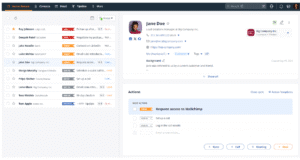
OnePageCRM works with the idea that when small eCommerce store owners know what to do next, they sell more. That’s why this simple CRM arranges your contacts by priority, so you never forget to follow up with buyers, process pending deals and orders, send quotes, or carry out some other activity to grow your store.
You can manage all your customers, deals, tasks, and your store’s sales workflow from a single page. You can also add products to your catalog, create quotes, forecast revenue, and monitor deals as they move through your sales pipeline.
And once a deal is closed, OnePageCRM lets you switch to a delivery pipeline to track its fulfillment.
Key CRM Features for eCommerce Small Businesses
Follow-up reminders: Keep your eCommerce workflow organized by showing which shoppers or leads need attention.
Product catalog: Sell faster by organizing all your products in the CRM and attaching them to deals and quotes in a few clicks.
Sales tracking with customizable pipelines: Monitor targets, forecast revenue, and move deals through both sales and delivery stages.
Order fulfillment: Use visual pipelines to track deals from the moment they’re placed until you deliver the items to the buyer.
Email sync: Sync your email client to send and receive emails without leaving the CRM. You can also build email templates and automate their delivery to cut down on time.
Marketing automation: Integrate with Mailchimp or other eCommerce apps to automate marketing campaigns.
Segmentation: Group customers based on shared traits—like tags, location, size, and the like—to run more targeted outreach.
eCommerce store sync: Connect your WooCommerce or Shopify store to view order history and customer data in one place.
Pros
Affordable pricing for small businesses
Simple interface that’s easy for non-tech-savvy store owners to use
Helps you stay consistent with follow-ups and prevent missed sales
Connects seamlessly with WooCommerce and Shopify for order tracking
Strong integrations with Mailchimp and QuickBooks for marketing automation and invoice management
Cons
No free plan, only a 21-day trial.
Pricing
OnePageCRM’s pricing starts from $9.95 per user/month. There’s a 21-day free trial, requiring no credit card details.
2. folk CRM
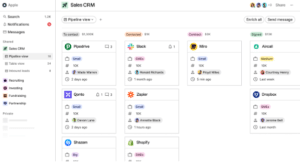
folk CRM is a lightweight CRM that helps eCommerce brands keep track of customers, repeat buyers, wholesale leads, and brand partnerships in one place.
Instead of a heavy “all-in-one” suite, folk focuses on clean pipelines and contact lists that adapt to different eCommerce workflows: DTC sales, B2B wholesale, influencer collaborations, or marketplace leads. Teams centralize contacts, follow conversations over email or WhatsApp, and use the folkX Chrome extension to capture shoppers and partners directly from social channels and the web.
Key CRM Features for eCommerce Small Businesses
Contact and lead management with segments for customers, VIP buyers, wholesale accounts, and influencers.
Customizable pipelines to track sales, pre-orders, wholesale deals, and collabs from first contact to paid order.
folkX Chrome extension to capture leads from LinkedIn, Sales Navigator, Gmail, and other social channels like Twitter/X and Instagram in a few clicks.
Email, calendar, and WhatsApp integration so conversations stay linked to each customer or account.
Simple email campaigns and follow-up sequences for launches, restocks, and post-purchase nurturing.
Shared views, comments, and tasks so support, marketing, and ops can work from the same customer record.
Pros
Very intuitive interface compared with traditional, feature-heavy CRMs
WhatsApp integration makes it easy to manage support and sales conversations from a channel eCommerce customers already use.
folkX saves a lot of time capturing influencers, partners, and B2B leads from LinkedIn and other socials into the CRM.
Flexible structure that fits eCommerce sales, wholesale, and brand-collab pipelines without complex setup.
Works well with other tools in the stack thanks to integrations and connectors like Zapier and Make.
Cons
No built-in inventory, warehouse, or order management; those still live in the eCommerce platform or OMS.
Advanced reporting is more limited than big enterprise suites.
Some eCommerce flows (Shopify, WooCommerce, marketplaces) rely on third-party integrations or automation tools rather than native apps.
No permanent free plan, only a time-limited free trial.
Best suited to teams that can spend a bit of time designing their own pipelines and views.
Pricing
Annual billing for folk CRM
Standard: $17.5 per member/month billed annually
Premium: $35 per member/month billed annually
Custom: from $70 per member/month billed annually
All plans come with a 14-day free trial so eCommerce teams can test folk before committing.
3. Venturz CRM
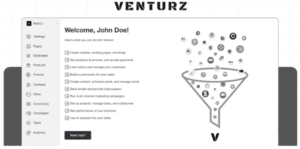
Venturz is an all-in-one business platform designed to power growing eCommerce brands with everything from CRM and sales pipelines to marketing automation, customer support, and even community-building tools—all under one roof.
For small eCommerce businesses, Venturz makes it incredibly easy to manage customer relationships, automate email campaigns, and track orders—while also offering advanced features like integrated live chat, landing page builders, and lead scoring tools. Whether you’re selling through your own storefront or across multiple marketplaces, Venturz centralizes your operations and helps you build lasting customer relationships.
Key CRM Features for eCommerce Small Businesses
Customizable sales pipelines to track every lead, order, and repeat purchase
Built-in email marketing tools with templates, automation workflows, and performance tracking
Live chat and ticketing system for real-time customer support
Community and membership features to build customer loyalty and engagement
Lead scoring and segmentation to prioritize high-value prospects
Landing page and funnel builder to capture leads and drive sales
Analytics dashboards for customer behavior, conversion tracking, and campaign insights
Pros
One platform for CRM, marketing, support, and more—no need for extra tools
Affordable pricing and free forever plan for small teams
Built-in tools for community building—great for DTC brands
Ideal for both digital and physical product sellers
Fully customizable pipelines and workflows
Cons
Still expanding native integrations with platforms like Shopify and WooCommerce
May offer more features than very early-stage businesses need
Pricing
Venturz offers a free forever plan with essential CRM and marketing tools. Paid plans start at $19/month with advanced features like automation, integrations, and analytics. No credit card required for trial.
4. Pipedrive CRM
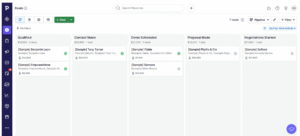
Pipedrive’s visual pipelines make it easy to see exactly where each deal stands, so eCommerce owners can stay on top of every sale. You can create as many pipelines as you like.
The CRM also lets you store your products, build quotes, and forecast future sales. Customer conversations, emails, and tasks are logged, so you always have full context when following up.
Key CRM Features for eCommerce Small Businesses
Visual pipelines for tracking sales progress
Product catalog for adding store items
Quotation and invoicing tools
Sales forecasting and goal tracking
Email tracking and communication history
Task reminders and follow-up alerts
Reporting dashboards to analyze performance
Pros
Intuitive drag-and-drop interface for sales pipelines
Strong focus on deal management
Free personalized onboarding for new users
14-day free trial available
Cons
No full email sync on the entry plan
Workflow automation is available only on higher tiers
Too expensive for eCommerce small businesses
Quality of customer support depends on your subscription plan
Interface can be overwhelming for small eCommerce businesses
Pricing
Pipedrive’s pricing starts from $14 per user/month. There’s a 14-day free trial, but no free plan.
5. Kommo CRM

Kommo helps small eCommerce online businesses turn conversations into sales. It pulls your customer chats from WhatsApp, Instagram, Facebook Messenger, Telegram, and email into one place. That means you can respond to customer questions, confirm orders, and close orders faster.
Beyond messaging, Kommo also gives eCommerce store owners tools to manage leads and track progress. You can add products, send invoices, forecast revenue, and integrate with your online store.
Key CRM Features for eCommerce Small Businesses
Unified inbox for WhatsApp, Instagram, Facebook, Telegram, and email
Visual sales pipelines
AI sales assistants for automating sales workflows
Product catalog
Dashboard and sales forecasting tools for business analytics
Integrations with Shopify and WooCommerce
Task reminders
Pros
Customer messages across social and chat apps are in a central inbox
AI bots and automation tools save time on repetitive work
AI agents provide 24/7 customer support
Centralized inbox for different messaging apps
Cons
Workflow and email automation features require expensive upgrades
Reporting and analytics are limited compared to larger CRMs
Reports of slow customer service
Pricing
Kommo’s pricing starts from $12.50 per user/month. There’s a 14-day free trial, though.
Final Thoughts
In the end, the right CRM for your eCommerce small business will depend on what you’re looking for exactly.
OnePageCRM is the best fit for small stores that want to stay organized, follow up consistently, and keep sales moving.
Zoho CRM gives you more room for customisation and deeper reporting, but it’s better suited for teams that are tech-comfortable and willing to spend time learning the system.
HubSpot works well if you want sales, marketing, and support in one platform, though it does get expensive as your online store grows.
Pipedrive is ideal if your store runs heavily on structured sales pipelines and lead tracking. Kommo, on the other hand, is ideal if you connect with customers through messaging apps and want a CRM built around that flow.
Good luck and happy selling!


